Friday, July 28, 2023

What is Gear Hobbing Machine Process?


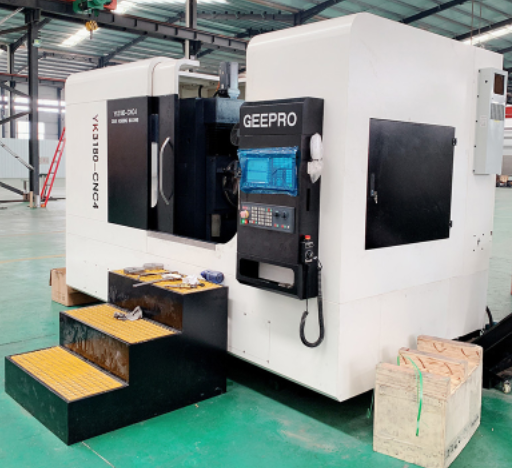
Gear Hobbing Machine


Hobbing machines provide gear manufacturers a fast and accurate method for cutting parts. This is because of the generating nature of this particular cutting process. Gear hobbing is not a form cutting process, such as gashing or milling where the cutter is a conjugate form of the gear tooth. The hob generates a gear tooth profile by cutting several facets of each gear tooth profile through a synchronized rotation and feed of the work piece and cutter.


As the hob feeds across the face of the work piece at a fixed depth, gear teeth will gradually be generated by a series of cutting edges, each at a slightly different position. The number of cuts made to generate the gear tooth profile will correspond to the number of gashes of the hob. Simply put, more gashes produce a more accurate profile of the gear tooth.


The hobs several cutting edges will be working simultaneously, which provide significant potential for fast cutting speeds and/or short cycle times. With this realization, one can see the hobbing process’s advantage over other cutting processes.


All gear hobbing machines, whether mechanical or CNC, consist of five common elements.

1. A work spindle to rotate the work piece

2. A cutter spindle to rotate the cutting tool, the hob

3. A means to rotate the work spindle and cutter spindle with an exact ratio, depending on the number of teeth of the gear and the number of threads of the hob

4. A means to traverse the hob across the face of the work piece

5. A means to adjust the center distance between the hob and work piece for different size work pieces and hobs
 

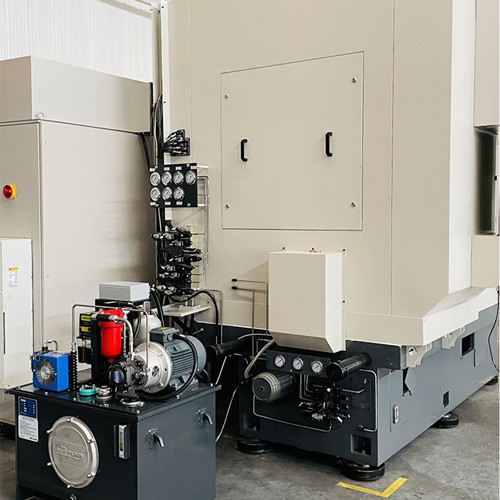
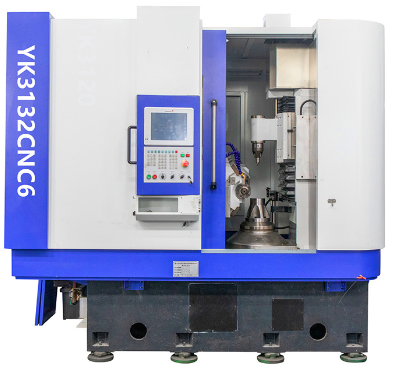
Gear Hobbing Machine


While the hob and work piece are rotating, the hob normally feeds axially across the gear face at the gear’s tooth depth to cut and produce the gear. In conventional hobbing, the direction of feed matches the direction of the cutting motion. Alternatively, in climb feeding, the feed is opposite to the direction of the cutting motion. Generally, conventional hobbing produces a better finish, whereas climb hobbing yields better tool life. For either method, the cutting forces of the hob should be directed towards the work spindle and not the tailstock.


Gear Hobbing Basics

Gear hobbing is a diverse and wide-ranging process that can be used to create several different gear types: Helical, worm and spur gears are some of the most common, but others are possible as well. It's carried out using a special form milling machine, one that contains a tool known simply as a hob.

The hob is the tool that directly generates the teeth for both gears and splines, and it does so with relative simplicity compared to other gear manufacturing types. It allows for high-volume production of these gear types.


The final words

To cut a helical gear, a standard hob cutter can be used. Mechanical hobbing machines provide a differential motion through a series of change gears to generate a gear tooth helix. Today, CNC hobbing machines electronically provide this necessary differential to produce helical gears. Contact gear hobbing machine supplier for a quote!

Thursday, July 13, 2023

The Difference Between Gear Shaping and Gear Hobbing

It is one thing to look at what gears do and how they work, but it is another thing to look deeper at how exactly gears are made and constructed. Today, that is exactly what we are going to do. Gear shaping and gear hobbing are both common ways to create gears.

Just like any sheet metal is fabricated to form the right mold, shape, size, and so on, gear manufacturing has certain machining processes such as shaping, hobbing, and so on. Gears are required to be set in motion, rotate, and raise the speed of any machine, industrial equipment, automobiles, and so on. So, how are these gears made? CNC machining methods are widely applied in the last stages of gear manufacturing, and milling, casting, forging, and so on are some of the methods used. Gear shaping and hobbing are also two important processes of gear manufacturing. The process to be used depends on gear specifications such as the shape and size required, among other parameters. This post discusses and compares the two methods- gear shaping and gear hobbing.


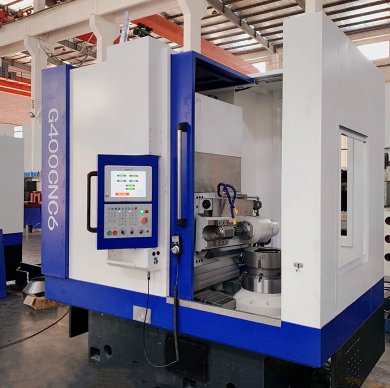
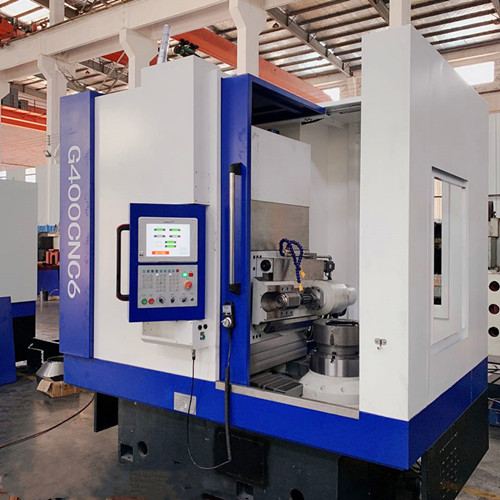
CNC Gear Hobbing Machine

CNC Gear Hobbing Machine


What is Gear Shaping?


This is a convenient and versatile method of gear cutting. Truthfully, this is one of the most popular production choices in gear manufacturing. This process is done by using a specific machine to create the teeth of the gear. Shaping is almost a subset of the milling process. This process helps form the gear teeth with the help of a rotating cutter tool, wherein its axis is parallel to that of the gear. The rotating speed and velocity of the cutter must match with the gear blank for teeth formation. A train of gears helps achieve the relative motion between the cutter shaft and the gear blank. Here the cutting may happen either at a downward or upward stroke. This is suitable for shaping of gears closely located toward the flanges or other obtrusive surfaces. This is widely used process for making internal and external gears. High dimensional accuracy is one of the major benefits of the shaping process apart from its cost-effective tools. After this process, surface finishing may be required depending upon the application.


What is Gear Hobbing?


Cutting splines, sprockets, and gear cutting, in general, is done using this process. Gear hobbing uses a special type of milling machine that allows for the teeth or splines to be progressively cut into the material by a series of cuts made by the tool this tool is called the hob.

Hobbing is a method also used for teeth formation in gear manufacturing. This teeth formation is done on the gear blank with the help of a hob on CNC gear hobbing machines. This machine is a type of special milling equipment. It could be an index hob or a master hob. There are various other types of hobs such as spline, spur, helical, chamfer, roller chain sprocket, straight side, and so on. The gear blank and the hob rotate simultaneously and produce continuous cuts on the blank gear which gives the required depth to the teeth. As mentioned above, the machining processes chosen are largely based on the shape and size of the gear. Likewise, hobbing is applicable for gear shapes such as helical, straight bevel, crowned, worm, face, and chamfering. Also, it is suitable for medium to high production volume. This cost-effective yet efficient process is useful to make several parts irrespective of the quantity.


Accuracy


There are benefits that come with each gear production. For example, the movement accuracy of gear hobbing is high. While that is not the case for gear shaping, gear shaping is more accurate in the surface finish. This is because the mechanic gear shaper is more complex. When comparing the two even further, the manufacturing process is simpler and easier to manufacture more accurately.


Productivity


In most scenarios, gear hobbing is more productive than gear shaping. This is because, in gear hobbing, there is not a large number of redundant metals. There is an instance, however, where gear shaping can compete with gear hobbing in terms of productivity. That scenario occurs when the gear is smaller in size and the teeth have a large and small-tooth width.

Looking at the accuracy and productivity allows you to better see the difference between gear shaping and gear hobbing. These two gear producing systems are alike, yet have their differences. Hopefully, this explanation gives you a better foundation to understand that.


If you are interested in CNC Gear Hobbing Machine or need a quote for a large project, be sure to contact us today!

Tuesday, June 27, 2023

Exploring the Different Types of Grinding Machines

Not to be confused with a milling machine, a grinding machine is a heavy-duty machine that's used to remove material from the surface of a workpiece. While milling machines feature a rotating cutting tool that's placed against a stationary workpiece, a grinding machine features a rotating grinding wheel, which is also placed against a stationary workpiece. There are several different types of grinding machines, however, each of which works in a different way.


Bench Grinding Machine

Bench grinding machines are characterized by their bench-like shape. They usually feature two different grinding wheels: one for the removal of material and another for finishing processes. They are called "bench grinding machines" because their grinding wheels are secured to the top of a workbench. As a result, bench grinding machines are easy and convenient for manufacturing workers to use.


Exploring the Different Types of Grinding Machines


Belt Grinding Machine

Belt grinding machines are characterized by the use of a belt sander. Like other grinding machines, they are designed to remove material from workpieces, thereby making workpieces smaller and with a smoother and more desirable surface. With belt grinding, the belt is coated in an abrasive material, after which it's run against the surface of a workpiece until the desired results are achieved. Belt grinding is most commonly performed on metal workpieces, though it supports workpieces made of other materials as well.


Surface Grinding Machine

A third type of grinding machine is a surface grinding machine. Surface grinding machines are unique because they feature an adjustable head. The head on a surface grinding machine can be lowered down to the workpiece. Once lowered, the head can then rotate back and forth under the machine's grinding wheel.

While belt grinding machines are typically used for finishing processes, surface grinding machines are most commonly used for material removal. When compared to other grinding machines, surface grinding machines are able to remove significant amounts of material, making them desirable for such applications.


Gear Grinding Machine


Gear Grinder


Gear grinding machines are designed specifically for the removal of material from shafts. Using grinding wheels, they can grind the center of a shaft with extreme precision.


Die Grinding Machine

A smaller and more basic type of grinding machine is a die grinding machine. Unlike the other machines listed here, die grinding machines are handheld. They are connected to an air compressor, which works to power the machine's grinding wheel. If an air compressor isn't used, the die grinding machine will likely receive power from an electric motor.


We are a gear grinding machine supplier. If you are interested in our products, please contact us now!

Sunday, June 11, 2023

Difference Between Gear Milling and Gear Hobbing

Gear is a vital component for rotating machines, with teeth mesh with another toothed part to transmit torque. How gears are made? Other than casting, forging, CNC machining can be applied to achieve the final shapes, dimensions, and surface finish of a gear. Here we introduce and compare two gear manufacturing methods – gear milling vs gear hobbing, what are the differences between them?


CNC Gear Hobbing Machine

CNC Gear Hobbing Machine


What is Gear Milling?


Gear milling is a common CNC milling operation and gear-cutting process of creating a gear. It can be operated either after or instead of forming processes including casting, forging, and extruding. Gears are usually made from metal, plastic, and wood. Many metal and plastic gears made by die-casting, injection molding, or additive manufacturing may not require cutting. For coarse-pitch gears, the generative gear milling technology can improve efficiency, expand the pitch capacity of the machine, reduce cutter cost, and may decrease the machining times.


What Cutter Used in Gear Milling?


The gear can be cut on a milling machine or jig grinder utilizing a gear cutter and indexing head or rotary table, the quantity of gear cutter is determined by tooth count of the gear required. Various types of cutters can be used for producing gears, for example, the rack shaper, with six to twelve teeth, straight and move in a direction tangent to the gear. The cutter has to move back to the beginning position for the new round cut.


What is Gear Hobbing?


Gear hobbing is also a gear manufacturing method to cut teeth into the blank with a hob like an index hob and master hob on CNC gear hobbing machines. The hob and gear blank rotate at the same time in a mesh and cut the teeth by continuous cut, the rotating hob is fed inward until achieving proper depth, then work for the entire gear. Gear hobbing is a great choice for medium to high volume production runs. The hobbing features for gears including straight, helical, straight bevel, face, crowned, worm, and chamfering.


How to differentiate gear hobbing and gear milling?


1. The way gear teeth are produced


In gear milling, a single tooth spacing or gap between gear teeth will be created by a rotating multi-edge cutter at a time, the cross-section of generated teeth is similar to that of the cutter. In gear hobbing, the gear teeth are progressively produced by a series of cuts with a hob. So the hob cuts several gaps simultaneously.


Hobbing Machine

Hobbing Machine


2. Cutter


Gear milling uses a rotating form cutter, when each tooth space is cut, the cutter will return to the starting point and gear blanks are indexed for next cutting process; gear hobbing uses a helical hob cutter, the hob and the workpiece are both rotating constantly when the hob is fed across the face width of the blank.


3. The number of teeth cut in one time


Each cutter in gear milling is designed to cut a range of tooth numbers, while in gear hobbing, both the hob and gear blank rotate continuously as in two gears meshing until all teeth are cut.


4. Price of tool


Generally, the gear milling cutting tool is cheaper than that of hobbing, but the productivity of gear hobbing may be higher.


5. Application


Gear hobbing is more often used for high production runs, and gear milling is a low production process.


6. Others


– Gear milling requires deburring

– Gear milling is often used when other generating processes are unavailable.


If you’re eager to learn more about the gear hobbing machine, or if you have an order you’re ready to place, contact GEEPRO today! We’ll have a quote back to you in less than 24 hours.

Tuesday, May 23, 2023

How Gear Hobbing Works

A gear hobbing machine contains two skew spindles. One of these spindles houses the hob, while the other houses the gear blank. The angle at which these spindles are placed relative to each other depends largely on the type of gear being manufactured.


Once the spindles are placed at the proper angle, the machine is set up to begin rotating the shafts at a speed ratio that suits the gear type. As the shafts rotate, the hob gradually cuts the teeth into the gear with the proper depth. To facilitate faster production, manufacturers can stack multiple blanks on the spindle together, allowing the hob to cut teeth into multiple gears at once.


Hobbing Machine for Cutting Gear


Just like there are multiple different angles, speeds, and techniques manufacturers can use to customize the process, there is also a wide variety of hobbing machines available for use. Most hobbing machines specialize in distinct applications. Hobbing machines are built to handle gears of a particular size and come in two different varieties: single-threaded and multi-threaded hobs. Multi-threaded machines allow for increased production, but they aren’t as precise as single-threaded machines.


Hobbing is one of the most fundamental processes in gear manufacturing. Its productivity and versatility make hobbing the gear manufacturing method of choice for a majority of spur and helical gears.


One of the most important concepts  to understand about gear hobbing is that it is a generating process. The term generating refers to the fact that the shape of the gear tooth that results is not the conjugate form of the cutting tool. Rather, the shape of the tooth is generated by the combined motions of workpiece and cutting tool. During hobbing, both the hob and the workpiece rotate in a continual, timed relationship.


For a spur gear being cut with a singlestart hob, the workpiece will advance one tooth for each revolution of the cutter. When hobbing a 20-tooth gear, the hob will rotate 20 times, while the workpiece will rotate once. The profile is formed by the equally spaced cutting edges around the hob, each taking successive cuts on the workpiece, with the workpiece in a slightly different position for each cut. Several cutting edges of the tool will be cutting at the same time.


During this rotation, the hob is typically fed axially with all the teeth being gradually formed as the tool traverses the work face.


High Speed Gear Hobbing Machine


The hob itself is basically a worm with gashes cut across it to produce the cutting edges. Each cutting tooth is also relieved radially to provide chip clearance behind the cutting edge. This also allows the hob face to be sharpened and still maintain the original tooth shape. In its simplest form, the hob tooth takes on the shape of a straightsided rack tooth. The final profile of the tooth is created by a number of flats blending together. The number of flats corresponds to the number of cutting gashes which pass the workpiece tooth during a single rotation. Thus, the greater the number of gashes in the hob, the greater the number of flats along the profile, which improves the “smoothness” of the tooth profile.


Geepro Machinery

WUXI GEEPRO GEAR HOBBING MACHINE has been one of the professional gear hobbing machine manufacturer and supplier in China since 2007.

Benefits From Our Advantages:

• Professtional Sales Engineers

• Stable Performance of Machines

• Reasonable Price For Users

• Long Life After-Sales Service

We provide high speed high accuracy gear machinery and other workpieces solutions with premium quality service to global users. Contact us now!

Tuesday, April 18, 2023

Know The Difference Between Gear Shaping And Gear Hobbing

Just like any sheet metal is fabricated to form the right mold, shape, size, and so on, gear manufacturing has certain machining processes such as shaping, hobbing, and so on. Gears are required to be set in motion, rotate, and raise the speed of any machine, industrial equipment, automobiles, and so on. So, how are these gears made? CNC machining methods are widely applied in the last stages of gear manufacturing, and milling, casting, forging, and so on are some of the methods used. Gear shaping and hobbing are also two important processes of gear manufacturing. The process to be used depends on gear specifications such as the shape and size required, among other parameters. This post discusses and compares the two methods- gear shaping and gear hobbing.


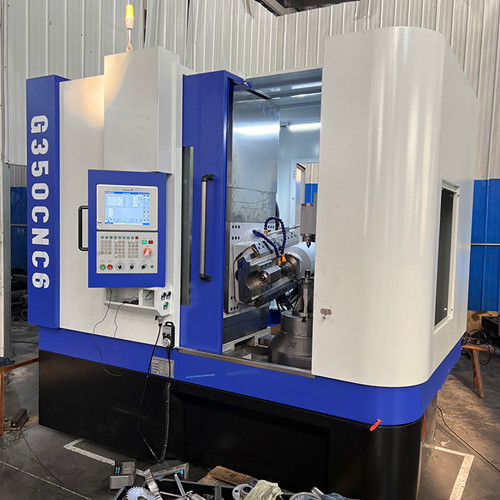
G350 6-axis High Speed Gear hobbing machine


What is Gear Shaping?

Shaping is almost a subset of the milling process. This process helps form the gear teeth with the help of a rotating cutter tool, wherein its axis is parallel to that of the gear. The rotating speed and velocity of the cutter must match with the gear blank for teeth formation. A train of gears helps achieve the relative motion between the cutter shaft and the gear blank. Here the cutting may happen either at a downward or upward stroke. This is suitable for shaping of gears closely located toward the flanges or other obtrusive surfaces. This is widely used process for making internal and external gears. High dimensional accuracy is one of the major benefits of the shaping process apart from its cost-effective tools. After this process, surface finishing may be required depending upon the application.


What is Gear Hobbing?

Hobbing is a method also used for teeth formation in gear manufacturing. This teeth formation is done on the gear blank with the help of a hob on CNC gear hobbing machines. This machine is a type of special milling equipment. It could be an index hob or a master hob. There are various other types of hobs such as spline, spur, helical, chamfer, roller chain sprocket, straight side, and so on. The gear blank and the hob rotate simultaneously and produce continuous cuts on the blank gear which gives the required depth to the teeth. As mentioned above, the machining processes chosen are largely based on the shape and size of the gear. Likewise, hobbing is applicable for gear shapes such as helical, straight bevel, crowned, worm, face, and chamfering. Also, it is suitable for medium to high production volume. This cost-effective yet efficient process is useful to make several parts irrespective of the quantity.


CNC Gear Hobber Machine


Accuracy

There are benefits that come with each gear production. For example, the movement accuracy of gear hobbing is high. While that is not the case for gear shaping, gear shaping is more accurate in the surface finish. This is because the mechanic gear shaper is more complex. When comparing the two even further, the manufacturing process is simpler and easier to manufacture more accurately.


Productivity

In most scenarios, gear hobbing is more productive than gear shaping. This is because, in gear hobbing, there is not a large number of redundant metals. There is an instance, however, where gear shaping can compete with gear hobbing in terms of productivity. That scenario occurs when the gear is smaller in size and the teeth have a large and small-tooth width.


The conclusion

Looking at the accuracy and productivity allows you to better see the difference between gear shaping and gear hobbing. These two gear producing systems are alike, yet have their differences. Hopefully, this explanation gives you a better foundation to understand that.

If you notice, the difference between these two methods is really in the way the gear teeth are formed.

If you happen to be searching for a company that can create custom made gears, look no further. Not only do we have skilled professionals who can create exactly what you need, but we will provide you with insight on all things gears as well.

Friday, March 31, 2023

The Difference Between Gear Shaping and Gear Hobbing

It is one thing to look at what gears do and how they work, but it is another thing to look deeper at how exactly gears are made and constructed. Today, that is exactly what we are going to do. Gear shaping and gear hobbing are both common ways to create gears.

Just like any sheet metal is fabricated to form the right mold, shape, size, and so on, gear manufacturing has certain machining processes such as shaping, hobbing, and so on. Gears are required to be set in motion, rotate, and raise the speed of any machine, industrial equipment, automobiles, and so on. So, how are these gears made? CNC machining methods are widely applied in the last stages of gear manufacturing, and milling, casting, forging, and so on are some of the methods used. Gear shaping and hobbing are also two important processes of gear manufacturing. The process to be used depends on gear specifications such as the shape and size required, among other parameters. This post discusses and compares the two methods- gear shaping and gear hobbing.


CNC Gear Hobbing Machine

CNC Gear Hobbing Machine


What is Gear Shaping?


This is a convenient and versatile method of gear cutting. Truthfully, this is one of the most popular production choices in gear manufacturing. This process is done by using a specific machine to create the teeth of the gear. Shaping is almost a subset of the milling process. This process helps form the gear teeth with the help of a rotating cutter tool, wherein its axis is parallel to that of the gear. The rotating speed and velocity of the cutter must match with the gear blank for teeth formation. A train of gears helps achieve the relative motion between the cutter shaft and the gear blank. Here the cutting may happen either at a downward or upward stroke. This is suitable for shaping of gears closely located toward the flanges or other obtrusive surfaces. This is widely used process for making internal and external gears. High dimensional accuracy is one of the major benefits of the shaping process apart from its cost-effective tools. After this process, surface finishing may be required depending upon the application.


What is Gear Hobbing?


Cutting splines, sprockets, and gear cutting, in general, is done using this process. Gear hobbing uses a special type of milling machine that allows for the teeth or splines to be progressively cut into the material by a series of cuts made by the tool this tool is called the hob.

Hobbing is a method also used for teeth formation in gear manufacturing. This teeth formation is done on the gear blank with the help of a hob on CNC gear hobbing machines. This machine is a type of special milling equipment. It could be an index hob or a master hob. There are various other types of hobs such as spline, spur, helical, chamfer, roller chain sprocket, straight side, and so on. The gear blank and the hob rotate simultaneously and produce continuous cuts on the blank gear which gives the required depth to the teeth. As mentioned above, the machining processes chosen are largely based on the shape and size of the gear. Likewise, hobbing is applicable for gear shapes such as helical, straight bevel, crowned, worm, face, and chamfering. Also, it is suitable for medium to high production volume. This cost-effective yet efficient process is useful to make several parts irrespective of the quantity.


Accuracy


There are benefits that come with each gear production. For example, the movement accuracy of gear hobbing is high. While that is not the case for gear shaping, gear shaping is more accurate in the surface finish. This is because the mechanic gear shaper is more complex. When comparing the two even further, the manufacturing process is simpler and easier to manufacture more accurately.


Productivity


In most scenarios, gear hobbing is more productive than gear shaping. This is because, in gear hobbing, there is not a large number of redundant metals. There is an instance, however, where gear shaping can compete with gear hobbing in terms of productivity. That scenario occurs when the gear is smaller in size and the teeth have a large and small-tooth width.

Looking at the accuracy and productivity allows you to better see the difference between gear shaping and gear hobbing. These two gear producing systems are alike, yet have their differences. Hopefully, this explanation gives you a better foundation to understand that.


If you are interested in CNC Gear Hobbing Machine or need a quote for a large project, be sure to contact us today!

What is the honing process? Machine honing explained

  Honing or Grinding? Choosing the Right Finishing Process for Your Needs in Modern Manufacturing Honing and grinding are both abrasive mach...